Disadvantages of a ceramic table, and what to do about them
Ceramic copes with heat, scratches, stains and sun, but it is heavy and sensitive to a hard knock on the edge. The disadvantages of a ceramic table and garden table, with what to do about each.
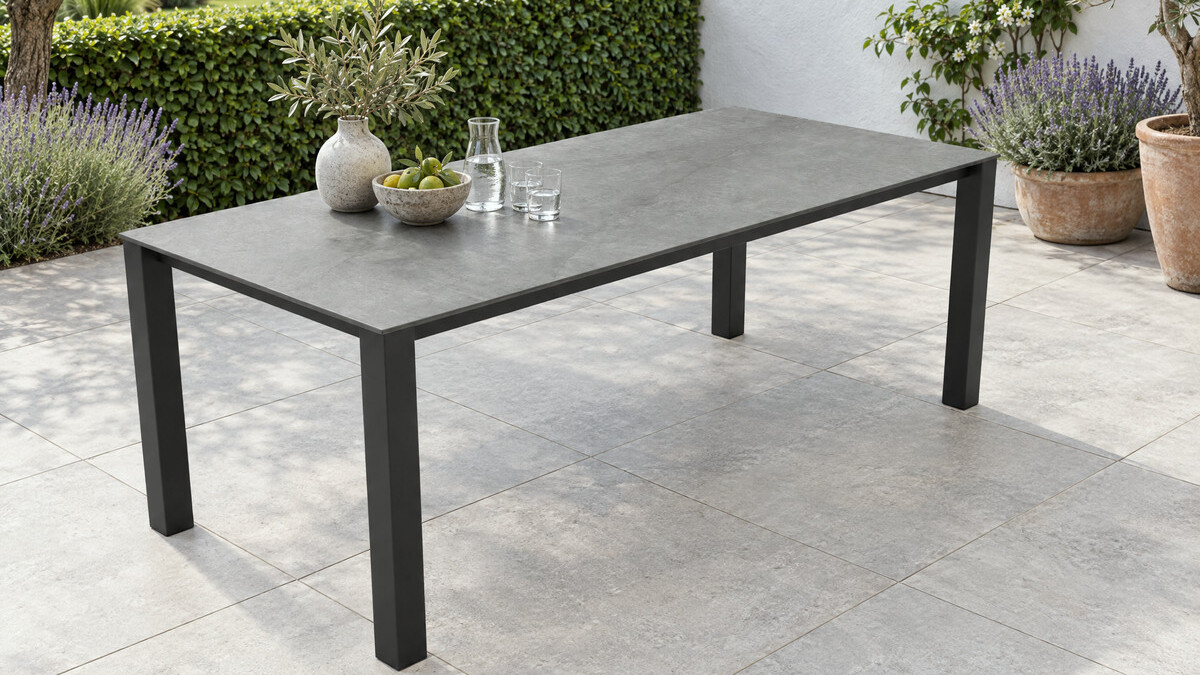
A ceramic table copes with heat, scratches, stains and sunlight better than almost any other top. Ceramic still has drawbacks, and they belong in the decision. For each one you will find what you can do about it.
Quick guide
- The table stays in one place and you want little upkeep: ceramic.
- You want to move the table often or carry it outside yourself: choose a lighter top or a smaller size.
- Chairs, toys or pots often knock against the edge: choose a matt top and a spot with room around it.
The disadvantages of a ceramic table
Almost every drawback comes from the same property: ceramic is hard and has a very low porosity. That makes the surface strong, but the top is also heavy and less forgiving of a hard knock on the edge.
1. Ceramic is heavy
A ceramic table top is 12 mm or 20 mm thick and weighs considerably more than a wooden top of the same size. You will not move the table on your own in a hurry.
Decide on a fixed spot first, indoors and certainly on the terrace. If you want to put the top on an existing base, check that the base can carry the weight.
2. The edge is the sensitive point
The surface is hard, but a hard point load on the edge can cause a chip. Think of a heavy pan dropped on a corner, a steel chair hitting the edge or a plant pot dragged across the top.
You reduce that risk with a spot where nothing keeps bumping into the table. A round or oval shape has no corners in the walkway.
3. Gloss shows fine scratches and rings sooner
On a polished or satin top you see fine scratches and rings earlier than on a matt top. The top is no softer; the light simply shows them more.
If the table is used intensively every day, a matt surface is the calmest choice.
4. A ceramic knife can scratch the top
Ceramic resists scratches and stains, but a ceramic knife is just as hard. Always cut on a chopping board, even when you are in a hurry.
5. A pan from the hob belongs on a trivet
Ceramic is heat resistant: a warm dish leaves no ring. A pan that comes straight from the hob, the oven or the barbecue still goes on a trivet, indoors and outdoors.
Protection that works
- A chopping board for every knife, including a ceramic one.
- A trivet for pans from the hob, the oven or the barbecue.
- Space around the table, so chairs and pots do not hit the edge.
A coating, oil or sealant is not needed: the top absorbs less than 0.1 % water.
Disadvantages of a ceramic garden table
Outdoors the same drawbacks apply, with weight as the main one. A ceramic garden table stays where it is; you do not carry it into the shed for winter.
There is no need to. Ceramic is frost resistant according to EN ISO 10545-12 and UV resistant, so the colour does not fade in the sun. A cover is not needed.
The base has to cope with the outdoors too
The top can stay outside, but the base must be able to as well. Stainless steel 304 is naturally corrosion resistant. A steel base gets an extra primer layer under the powder coating for outdoor use.
Steel with primer and stainless steel can both stand outside; on steel, damage to the coating can start to rust. Beyond that, the choice between the two is about looks. See the ceramic garden tables for complete tables.
Ceramic, granite or oak: the drawbacks side by side
Every material has a weak point. Choose the one whose weak point clashes least with how you use the table.
| Ceramic | Granite | Oak | |
|---|---|---|---|
| Main drawback | Heavy, edge sensitive to a hard knock | Needs sealing, not heat resistant | Moves with the humidity |
| Hot pan | From the hob on a trivet | Always a trivet | Always a trivet |
| Care | Damp cloth | Seal on arrival and every 2 to 3 years | Damp cloth on the lacquer |
| Outdoors | Yes | Yes | No |
| Thickness | 12 or 20 mm | 30 mm | 40 mm |
If you want real natural stone and do not mind sealing, look at granite table tops. For warm wood indoors, an oak table top fits. The full comparison is in ceramic or granite.
What does a ceramic table cost?
The price depends on size, shape, thickness, colour and base. In the 3D configurator you see the price straight away with every choice, without asking for a quote.
When you compare with other suppliers, always compare the same size and thickness. A 12 mm top and a 20 mm top are two different tables.
When is ceramic the right choice?
Ceramic suits a table that is used every day and should ask for little attention. Wine, oil or sun cream do not soak in, and the colour stays the same in the sun.
It suits you less if you want to move the table often, or if it stands in a narrow walkway where something keeps hitting the edge. Also read what to look for in a ceramic dining table.
Choosing a colour without regret
Ceramic comes in 29 colours, from marble look to plain shades. Order material samples and look at them in your own light, indoors and outdoors.
See it for yourself in Maasbree
In the showroom in Maasbree, Netherlands you can put ceramic, granite and wood side by side and feel the difference at the edge. Separate tops are under ceramic table tops, complete tables under ceramic dining tables.
Every top is made to measure in the workshop in Maasbree. You get a 2-year guarantee on construction and finish.


